Best Light Bulbs for Selling House
Best Light Bulb
What are the best light bulbs when selling a house? Buying a light bulb used to be very easy. You went to the grocery store or hardware store and you had a selection of the famous incandescent light bulbs, which everyone is familiar with:
Your hardest choice was 40 watts, 60 watts, or 100 watts, frosted or clear.
Now when you walk into a hardware store you have a choice of a few energies efficient incandescent, those horrible, curly CFL fluorescent bulbs (which contain mercury and should be disposed of as hazardous waste). halogen bulbs (which burn very hot – they’ve been known to melt light fixtures when used in the wrong place) and LED bulbs. All are relatively cheap, except halogen, which I avoid anyway due to heat production.
Of all the bulb types, LEDs are the most energy efficient and can last up to 10 years per bulb! They used to be expensive, but you can buy them for as little as $1 at the Dollar Tree or other dollar-type stores. Just make sure they fit your purpose. For example, not all LED bulbs are dimmable or suitable for outdoor use.

Which light color should I buy?
Most light bulbs come in 4 “colors”: soft white, warm white, bright white, and daylight. Colors are based on units called Kelvins (K). Lower Kelvin means more yellow light. The higher the Kelvin number, the whiter or bluer the light.
- Soft white (yellow form) – 2500K-3000K. This is a common color associated with old-fashioned incandescent bulbs. This is the color of light we are most familiar with and feel most comfortable with.
- Warm white (between yellow and white light) – 3000K-4000K.
- Bright white (between white/neutral and cool light) – 4000k-5000k.
- Daylight (blue/cool colored light) – 5000K-6500K.
- Soft white, 2700K, is a soft yellowish light; cool white, 4100K, slightly whiter than soft white; Daylight, 5000-6500K, blue, white light, similar to cloudless afternoon
For my money, I prefer a 3000K light bulb. The color temperature of the light closely approximates the light of an incandescent bulb, which is the most flattering light and the one we are most accustomed to. They are usually sold as soft white or warm white. As long as they are 3,000K (you can find this information on the back of most light bulb boxes) you are good to go.
The color temperature of the lighting in a home can affect a buyer’s perception of the home.
Is it warm and welcoming or is it cold and clinical? Does the house feel comfortable or does it feel like a hospital corridor or a dentist’s office? The best scenario for a home buyer is to feel cozy and comfortable, so they can imagine themselves living in the home.
We typically see a mix of incandescent, curly CFLs and LEDs in the same house, sometimes in the same room, before staging. When photographing a home, all those different light bulbs look different in the photos. For the best-looking home photos and the best buyer experience during open houses and showings, all recessed light bulbs must match and all have a wattage of approximately 3,000K and at least 800 Lumen (approximately 60 watts). equal) should be 800 Lumen Warm White bulbs are also the best color temperature and wattage for the lamp.
Go to the Dollar Tree and buy this $1 light bulb! These are t
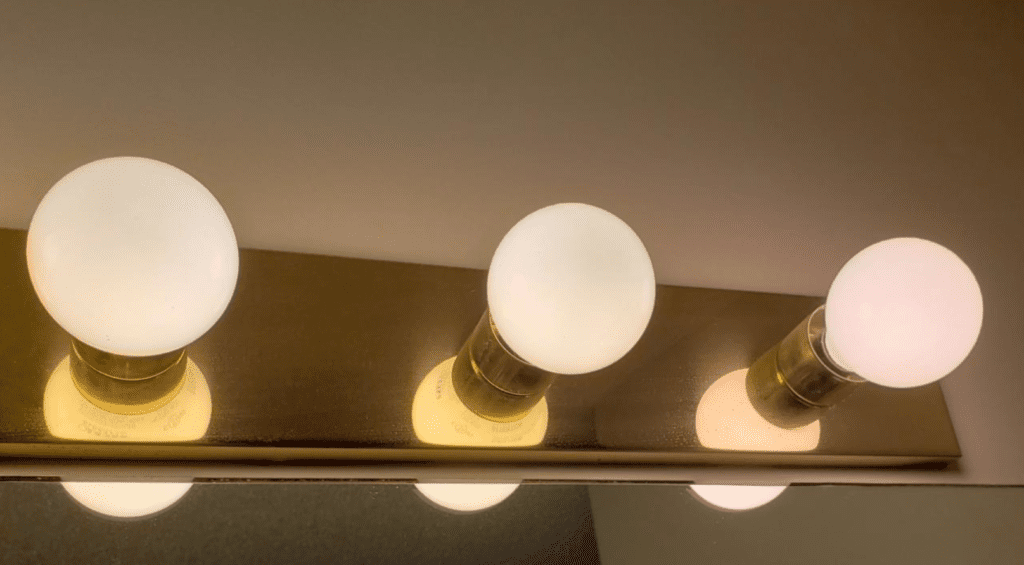
he best light bulbs when selling a home.
If you were trying to get really fancy, you could get one of these three-way light bulbs for a lamp that gives you a brighter and brighter option. With the advancement in energy efficient bulbs, just knowing the wattage is no longer enough.
As a home stager, one of the most common (and most easily fixed) “boo-boos” I see among home sellers is using the wrong light bulb for the job. Replacing light bulbs can have a big return on investment, not only in terms of energy costs but also in terms of its visual impact on potential buyers. Even a subtle change in lighting can make a big difference in the ambiance of a room! The next time you’re shopping for the best light bulbs to showcase your home, be sure to check out these four important details:
Type of light bulb
For homes, LEDs are generally better than all other types of light bulbs because they:
Has the longest lifespan (10 years or more)
Are more durable (solid structure, no glass or fiber)
Emit excellent quality light (available in a range of color temperatures)
Use the least amount of energy (changing just one bulb saves about $52 a year in energy costs)
The cost of LED bulbs has also dropped so much in recent years that the bulbs pay for themselves in months.
Avoid CFLs and halogen bulbs. CFLs contain mercury and take a long time to heat up. Halogens use a lot of energy and generate heat.
When choosing a color for your light bulb I recommend following two rules. One, have a clear goal, and two, be consistent.
When shopping for bulbs, it can be an overwhelming and confusing task. There is so much information out there, sometimes conflicting, that there is no easy standard to follow. As a home seller, choosing the right color bulbs will determine how your home will look to a buyer. Choosing the right bulb to use will depend on what your goal is when lighting the space. When it comes to home interiors, lighting can do two things. One is to bring light and comfort to the space and home in which one resides. Two, lighting can best represent and highlight the best and unique features of a particular space or space within a home that is either being marketed or advertised.
First, let’s talk about the color of your home bulb. Two important questions that immediately come to mind: How many types of bulbs are there? What is the ideal color to use when it comes to selling a home?
Let’s tackle the first question. There are 3 of the many adjectives we use regularly in our everyday language to describe the color of our household bulbs. ‘Warm’, ‘Neutral’ or ‘Cool’. ‘Warm’ indicates an amber (orange) color, while ‘cool’ indicates a more bluish (blue) color, and ‘neutral’ emits no color at all (white).
However, when I Google the term ‘white bulb’, I actually find 5 or more types of white bulbs, which coincidentally each emit a different color besides white: ‘warm white’, ‘soft white’, ‘bright white’, ‘cool white’, ‘daylight’ etc. When you actually walk into a store like Target or Lowe’s, you’ll usually find a light bulb section that offers all sizes, shapes, and yes, colors. So how do I decide which ‘white bulb’ color to use?
After taking 1000’s of photos of homes for sale or rent, as a professional real estate photographer, I have come to use only two types of ‘white’ home bulbs for my photos: ‘soft white’ and ‘daylight’. If you can’t remember which ‘white’ bulb to use, you can also identify the bulb by its ‘color temperature’, a four-digit number followed by the letter “K”, usually but the bulb itself is sealed. The box it came in. A ‘soft white’ bulb is not actually white, but emits an amber color, and has a color temperature of 2700˚K, while a daylight bulb, which emits a neutral white light, its color temperature. A 5000˚K 2700˚K bulb emits the same color as the sun when it sets or rises above the horizon or an old-fashioned Edison incandescent tungsten bulb. A 5000˚K ‘daylight’ bulb emits the same light as the sun emits in the middle of the day without clouds. Additionally, because ‘daylight’ bulbs are color neutral, any colors you use for decor or wall paint will be more accurately represented in your home staging and photos.

As a home seller, whether you’re a property owner or a realtor, I imagine you’ll want to show the home’s interior lighting, to assure a potential buyer that the home’s electrical system is in good working order. More importantly, it’s a way to highlight a home’s unique architectural features that make it more salable, more marketable.
I will say this first. There is no specific way to light your home. It all depends on the following three factors:
1. Amount of natural light
2. Direction of natural light
3. Special staging or design
The amount and size of windows will determine the amount of natural light that can enter the space. The architectural design of the home in terms of window placement will determine the direction from which natural light is coming into the space, and the staging or placement of furniture will determine whether to include more interior light fixtures. All of these factors will ultimately determine how you present and/or image your space.
Remember the two principles I mentioned at the beginning?
Have a clear goal and be persistent “Know your purpose.”
When I’m building a house to sell, and I bring in furniture and colorful accessories to add more visual interest to different spaces, I like to use 5000˚K daylight to show the house as well as my stage. i do What I love about this light temperature is that it emits a neutral white, it doesn’t change any of the colors I use for my decor or wall colors. It also closely matches the natural light coming in from my windows, resulting in more natural light into the space.
For example, if I have a gray sofa with blue throw pillows, and I have a table lamp that emits a neutral ‘daylight’ color, it won’t change any of the colors of the furniture and accessories. . On the other hand, if I use ‘soft white’ (2700˚K) lighting, which produces an amber glow, the sofa’s gray color will become more gray and blue-green.
I also prefer daylight when it comes to accurately showing house paint colors, whether the walls are white, gray or beige, or any other color, the daylight color of your light is up to you. Will accurately display color differences between mains. Wall paint, accent colors and trim.
“Keep it steady”
A general rule I follow is to match your lighting, especially if the home is being sold as vacant or occupied. This means trying to color all the bulbs in the house, whether it’s ceiling fixtures or bathroom fixtures or table lamps. So, whether you choose a 2700˚K ‘soft white’ bulb or a 5000˚K daylight bulb, be consistent.
The only caveat I have is about mixing some 2700˚K soft light with 5000˚K daylight, when you want to show some light fixtures in your staging or design, and some spots of warm color more. But I want to show it in white color. Or a neutral-colored room to give it some mood and life.
“There is always an exception to the rule.”
Much of what I’ve said so far applies to how you, as a seller, homeowner or realtor, can effectively market a home for the purpose of showing it for sale. Will show in the best possible light. On the other hand, if my only intention or purpose is to live in a space, I would prefer to use 2700˚K soft white light for all or most of my fixtures, due to its warmth and low energy level. It is easy. ‘ on the eyes.
However, I would use reserve and caution when using 5000˚K lighting for my personal environment. The bulb emits a high-energy light wave, which can affect you emotionally and psychologically. See the following article:
- Blue/white light makes us excited and can disrupt sleep patterns around bedtime due to the fact that blue light suppresses melatonin levels. Brain cells are most sensitive to blue wavelengths and least sensitive to red wavelengths. Blue wavelengths can also affect people who are blind when it comes to circadian rhythms.
- Red/amber light is the light least likely to affect our internal clocks. Red light in the evening can help improve mental health. This is because red light in the evening helps to increase the release of melatonin, which leads to a better night’s sleep. A better night’s sleep leads to better cognition and overall mental well-being.
I hope I’ve been able to clear up some of the confusion surrounding the use of household light bulbs when it comes to showing and photographing real estate. Feel free to contact me with any questions you may have about how to best represent your home for sale.
Light bulb shape
Save yourself multiple trips to the hardware store by taking old bulbs with you when you go shopping. It’s also not a bad idea to use your phone to take a few photos of the light fixture. LEDs are now available in a variety of shapes and sizes, but new technology may mean a slightly different design than your old bulb. Make sure your bulb fits perfectly by coming out with the correct information.
The glow of a light bulb
Wattage only tells you how much energy a bulb uses – not how bright it is. Because newer light bulbs such as LEDs use so little energy, wattage is not a reliable way to measure the brightness of a light bulb. Instead, we use lumens.
Brightness is measured in lumens, not watts. The higher the lumens, the brighter the light. A standard 60-watt incandescent bulb, for example, produces about 700 to 800 lumens of light. In comparison, a CFL bulb produces the same 700 to 800 lumens using only 12 watts of electricity. An LED bulb uses even less energy to produce the same amount of light – just 10 watts. You can use lumens to compare the brightness of any bulb, regardless of whether it is halogen, incandescent, CFL, or LED.
When listing your home for sale, we recommend the brightest bulbs* possible, usually around 750 lumens or more. You can find a bulb’s lumens on the package’s Lighting Facts label under “Brightness.”
*If for some reason you are not using energy efficient LEDs, wattage may still be a relevant factor to check. For safety reasons, make sure you don’t use a bulb that exceeds the light fixture’s recommended wattage, or energy consumption.
Indoor recessed lighting
When it comes to indoor recessed lighting, you’re usually looking for either a BR30 or BR40 bulb. The BR40s diffuse the light slightly more than the BR30s, but the difference is subtle. We recommend selecting bulbs for recessed lighting based on lumens output, color temperature, and can size.
Most cans are 4″ or 5″ or 6″. Generally, a 4″ can only accommodate BR30s. A 5″ BR30 can fit the bulb comfortably with little room around it, while a BR40 will fit more comfortably. A 6″ can will accommodate a BR30 bulb but it will also leave too much space between the bulb and the trim, a shape you won’t care about.
A dimly lit room can be a romantic gesture, but it’s not the best way to make buyers fall in love with your home! Staging your home with proper lighting can be the difference between a buyer seeing your home as a dark dungeon, or a warm and inviting place to raise their family. Let’s look at some techniques to help brighten up your home and sell it fast!
Sunshine is free!
Natural light is the first easy way to improve the appeal of your home. If you have a house with big windows, open those blinds! Dark and heavy curtains can set the mood in a room, but letting in natural light makes the room feel bigger. Sunlight at home has beneficial effects on both mind and body, take advantage of this free resource! Let Mother Nature do the work for you!
Lumens and color temperature
The general lighting in your home should be bright and cheerful without making the rooms feel sterile. Standard light bulbs come in four general types. Soft white, warm white, bright white, and daylight.
Soft white bulbs have a warm yellow cast and are rated at 2500-3000K. These are more similar in color to old fashioned incandescent bulbs. When they light up a room, they can feel a dim, as the name suggests, soft white. If you use them in your home, they may be best suited for bedrooms, where you want the feel to be inviting and comfortable.
Warm white bulbs are rated at 3000-4000K with a slightly less yellow hue. Warm white will add a pleasant glow to your home without being overly white. Place these lights in living rooms and dens where you want people to feel the openness of the room, but still enjoy a cozy atmosphere.
Bright white bulbs are perfect for washing a large room with fresh, more energetic color. Office spaces and kitchens are ideal places for these vibrant bulbs. 4000-5000K light is close to a daylight bulb, without being as harsh.
Daylight bulbs are the bluest in the standard white range. The light can feel a little clinical, which is perfect in a bathroom, kitchen, or home office. This light mimic natural daylight with its 6500K range and is beneficial in increasing the body’s natural serotonin production.
Illumination with Lumens
Many of us are old enough to remember when every light bulb was rated in watts. Wattage was determined by how much power a bulb used. LED bulb packages still mention wattage equivalents, but we now favor the more comprehensive measurement, lumens. What is a lemon?
Lumens are all about light intensity. When lighting our home, we need to consider how much light each room should have. Enough light is needed to illuminate every corner of the room without glare. Most rooms will benefit from around 3000 lumens. A standard 60W equivalent LED bulb will produce an average of 800 lumens. Ceiling fans often come with 3 or 4 light fixtures. Make sure all these lights are in working order. A four-light fixture filled with 800-lumen lights brings 3200 lumens into the room, exactly what you want! If your fixture only accepts three bulbs, consider using a 75-watt equivalent LED light that produces about 1100 lumens. It makes your room a little brighter than a four-bulb fixture!
Work light
Large rooms and rooms with high ceilings will need more light. Task and accent lighting is a great way to achieve this requirement. An easy way to determine whether your room has enough light is to grab a book. Any book will do (or print out my blogs and use them!), and walk around the room. Can you read the pages easily? Are you tired of looking at words? You can take advantage of moving floor or table lamps to light up those shadowy corners!
Adequate lighting makes buyers feel warm and safe, dispelling the perception that the seller is hiding anything. Show off the beauty of your home! If you’ve spent hundreds of dollars on a fresh coat of paint, or thousands of dollars on a kitchen or bath remodel, you want buyers to see the improvements! Spend a few extra dollars and make your home shine!
Too high? Make it super bright
If you have rooms with high ceilings or recessed lighting – for example an entryway, or maybe a staircase with overhead lights or a sconce above – you may want to prioritize brightness over softness in your light bulbs. will After all, the higher your light bulbs are, the brighter they have to be to illuminate the room.
The most common products for overhead lighting are BR30 shaped floodlights. “BR” stands for “bulging reflector” and means that the light inside the bulb sits on top of a reflective dish, like a small satellite dish. Install a bulb like this in your ceiling, and that bowl will catch all the light cast upward, then reflect it down and down, creating the widest possible pool of bright light in the room. emerges outward. This is the same trick that your car’s headlights use to create as much light as possible in front of you as you drive.
Perfect for high ceilings
You have energy-saving LED options in the form of BR30 in aisle lighting. The most common choice among these are 65-watt replacement bulbs that typically put out about 650 lumens each. This is fine for a good, average number, and average height ceilings with at least a few bulbs shining on top. Among the ones I’ve tested, the 65-watt replacement floodlights from Curry’s and Philips are the two I’d recommend. They are good value and they are extremely energy efficient for the money (each draws less than 10 watts). These dimmable bulbs also work well with dimmer switches and — most important for overhead lighting — they’re both nice and bright, comfortably putting out more than 700 lumens each. At the time of this writing, Home Depot has curry bulbs on sale for less than $6 in a two-pack — these are the ones I’d carry in my house if I could buy them.
If your ceilings are higher than average, or if you have fewer overhead bulbs than you’d like, then look for 100-watt bulb replacements with BR30 LEDs that boost brightness even more. Curry makes them, and Home Depot is selling them for a little over $10 each, which is a great deal.
Dimmability means versatility for your living room and bedroom
Some rooms serve only one or two primary functions, but other rooms are used in every way. For example, you can use your room for watching TV, reading books, playing board games with the kids, or any number of other activities. Rooms like this can really benefit from quality lights that can match whatever is going on.
The old-fashioned way to do this is to use a mix of different lamps and fixtures that serve different purposes — reading lamps next to your favorite armchair, overhead lights for board game night, when you watch a movie. If you see everything off, and so on. That’s all well and good, but it limits you to a binary, “on/off” lighting mentality.
Better view? Give yourself a full spectrum of lighting possibilities by making sure all those lights are dim.
Upgrading your light switches to dimmer switches is one way to do it (and not as scary as you might think if you’ve never switched out before). There are also smart plugs from brands like Lutron that will let you turn your fixtures and lamps up and down. However, the easiest way is to replace your bulbs with dimmer smart bulbs. Now’s a great time to do it — costs have come down a lot in recent years, and the advent of voice controls has given people a quick, easy way to dial in any dimming setting they want. whenever they want.
Best of all, almost every smart bulb on the market is dimmable without flickering or buzzing, eliminating a common headache that comes with in-wall dimmer switches. This also makes smart bulbs a quality pick for bedrooms, where strong dimming performance and preset wake-up dimming can do wonders for your mood in the morning.
The best dimmable smart bulb
Philips Hue White Starter Kit
Philips Hue has a reputation for being expensive, but its dim white LED smart bulb costs just $15, and you can get a starter kit with three bulbs and a Philips Hue Bridge that’s the brains of the system for just $60. does. From there, you can pick up an additional bulb each time they go on sale, gradually building your network of connected bulbs.
We like the Philips Hue smart light bulb because of the well-designed app, the robust variety of bulbs, fixtures and accessories you can add to your setup, and the good track record of support. With Hue Bridge calling the shots, your bulbs will work with Siri, Alexa and Google Assistant for instant, voice-activated lighting changes. The next time you’re watching a movie and want the lights dimmed, but not turned off completely, you can simply tell your assistant to “Dim the living room lights to 5%.” “
Consider your kitchen and closet colors.
I’m not talking about color-changing smart lights (although if you want to jazz up your home with them, don’t let me stop you). No, I’m talking about colors that are already in your home – artwork, furniture, clothes in your closet, fruits and vegetables in your kitchen, you name it.
Whatever it is, if it’s colorful, it will benefit from light bulbs with a high color rendering score — bulbs that increase color temperature and help colors look their best. This isn’t always the easiest thing to shop for, as manufacturers aren’t required to list their color rendering scores on the packaging, as they are with brightness and performance specs. Some bulbs that claim to emit great colors actually do.
Best bulbs for better looking colors
GE revealed the LED.
My LED lighting tip: Stick with GE Reveal bulbs, because after nearly six years of reviewing light bulbs for CNET, I’ve yet to do a test that confirmed my own for better-looking colors. Did not fulfill the promise. This includes standard 60-watt replacement LEDs, floodlights, weird-looking stick-shaped LEDs, dimmable LED bulbs, and more. A 4-pack of regular, A-shaped reveal bulbs (linked below) is currently $17 at Lowe’s.
They cost a little more per bulb, and most are a little less bright than the average LED light because they filter out some of the extra yellow light for a better color temperature — but if you’re using them If so, this compromise is worth it. For accent lighting or to brighten up areas in your home where you’ll appreciate accurate, better-looking colors day after day.
And that’s really the point — despite regularly realizing them, we use more light bulbs in our homes than anything else. They are often the first things we turn on in the morning and the last things we turn off before bed. So don’t let the light aisle overwhelm you — whether you choose an energy-saving light bulb, a CFL bulb, a smart LED bulb or even a regular incandescent light bulb, for every room in your home. Finding the right lighting is well worth it. That, and it’s easier than you think.
Selling your House
Selling your house can be a real drag. It seems like it has been on the market forever. Many realtors suggest that the best way to quickly increase buyer interest is to stage your home. But, even if you have all the right furniture in all the right places, low lighting in your home can make the most beautiful decor look cluttered and uninviting. Here are a few rules to follow when staging your home.
Rule #1:
Brighter is better. A dark house turns off potential buyers. Having a bright, well-lit home shows that you are confident about its cleanliness and that you have nothing to hide. Add task lighting throughout the home. Undercabinet lighting is an easy way to add value and give your kitchen a premium look. Invest in a few floor lamps for any dark corners in the living room and bedrooms, as well as reading lamps on nightstands and end tables. If you have high ceilings, make sure the light reaches all the way through so the space doesn’t feel smaller than it actually is. Remember you’re trying to sell a home, not set the mood.
Rule #2:
Pay attention to color temperature. Color temperature has a big impact on the buyer’s perception. According to staging and design expert, Sam Jernigan, from Renaissance Design Consultations, “Some bulbs have warmer colors, which are more flattering for skin tones.” People like homes that look good on them. So, if your bedroom and living room have ambient lighting with a cool white color temperature, you may want to invest in bulbs with warmer tones around 2700 Kelvin. Some realtors recommend using light pink light bulbs in homes. Yellow, pink colors give a healthy glow to rooms and skin tones. Cool white lights at or above 3000 Kelvin should be reserved for task lighting.
Rule #3:
Dimmers are your best friend. It may seem like a small thing to add, but dimmers are practically an essential item nowadays. Dimmers allow you to maximize the brightness as potential buyers walk in, while giving them the option to dim the lights to get a sense of the ambiance the space can provide.
Rule #4:
Don’t neglect the bathroom. They may get a lot of traffic, but bathrooms can be easily overlooked. Use sconces on either side of the mirror or vanity lights above. Around the mirror is the area that needs the lightest. Re-angled light to bounce off walls instead of pointing straight down. This will reduce glare and shadows, making the room appear brighter. Consider adding lighting in the shower that is UL listed for wet locations or an IP67 rating. It is often a very dark place compared to the rest of the room.
Hayden is a longtime board member of the local real estate staging community in Austin for both RESA and IAHSP. Before Covid-19, Hayden conducted photography workshops around the country for real estate, design and home staging professionals, and now conducts his own group and online courses. He also has a great instructional video on YouTube that you might want to check out.
As a filmmaker, he has been involved in film productions in Paris, Los Angeles, Honolulu and Austin for over 20 years. He has taught digital film production full-time at the Art Institute of Austin. Hayden recently released his first feature documentary, A Force in Nature: Jóhann Eyefuls, which won recognition at several film festivals, including “Best Doc” at the Hill Country Film Festival in Texas and DIY in Santa Monica, CA. film festivals, and is currently showing on network TV in Iceland.