How to pick the right size wall mirror
Choose a mirror that is perfect for your wall
The right mirror on your wall can give an entire space a whole new life. Since mirrors will only reflect what is in front of them, choose the wall carefully. Reflections become part of your room. Feng Shui experts say that mirrors should only face certain directions, and should not be blindly placed on any wall. In any case, choose the wall carefully.
Mirrors serve many functions. Use one to enhance, define, or emphasize what’s already in your space, or place it where it reflects a favorite scene. You can also use mirrors to open up a room or add light.
The three most important things you should look for when choosing a mirror are shape, size, and style.
Find a shape that works for you.
- As you may have already noticed, shape plays an important role in defining any space. It can create a mood, emphasize what is already there, or give the illusion of something else.
- A long horizontal shape will work to accentuate the width, as it helps your eye sweep along the long line. A long vertical shape will draw attention to the height as it makes your eye travel upwards.
- An angular shape such as a square or rectangle will help give a streamlined look.
- Depending on the style of its frame, use round or curved frames for a soft or perhaps whimsical look.
- You can even combine several mirrors to create a look the way you do with pictures or framed art.
Why size matters
The size of your mirror can affect the effect you want to create. Size selection should also be based on whether you want the mirror to serve as a focal point, accent, or simply as a background.
- A small mirror on a large wall will look lost and modest. Choose a size that fits your chosen wall.
- If you want your mirror to be a focal point in your room, make sure it’s large enough to stand out, but also define it by choosing a frame that frames it. And make it more prominent.
- If you want your mirror to become part of the background, you should choose one that is larger so that it works to make your space look bigger. Don’t give it a frame that draws attention.
- Small mirrors can be used as accents, catching light here, reflecting something interesting there. They can also be used in groups. If you plan to use small mirrors in groups, remember that they work together to create a larger look and can act as a focal point in the room.
It’s all about style.

Your mirrors can reflect the style that already exists in your room, but you can also create a great effect by choosing a style that is unexpected and therefore acts as an accent. does. While the shape and size of the mirror matter, the frame plays an even greater role in determining the style.
- An ornate, carved or gilt frame is often used in a more traditional or ethnic culture-inspired environment but can be used for contrast in a more modern one.
- A high frame with simple lines or unusual materials is often more suitable for a casual or modern interior.
- Whimsical frame treatments and distressed looks work well for a country look, or even in an eclectic room.
Best sizes and heights for wall mirrors – expert advice!
You have several blank walls in your house and you have a collection of mirrors. How do you hang your mirror for the best effect? What are the recommended sizes and heights? Learn everything you need to know in this comprehensive guide.
Mirror placement is partly a matter of taste but there are important rules: Use the rule of quarters to place your mirror 3/4 of the way between the floor and the ceiling. Make your mirror 2/3 to 3/4 the width of the furniture below. Most mirrors should be hung about 5 feet above the ground at eye level.
Should I use a mirror or a mirror gallery?
An important choice for interior decorators is whether to use a single, large, show-stopping mirror or go for a collection of smaller mirrors known as a gallery wall.
If you have a collection of small mirrors and want to create a gallery wall, follow these tips:
If you have a collection of small mirrors and want to create a gallery wall, follow these tips:
It’s a good idea to vary the shapes and sizes of your mirrors, but experienced designers recommend unifying groups around a theme such as frame styles—contemporary, traditional, country, southwestern, gilded, or rustic. .
Other themes can be related to the frame’s texture: think Mexican tin, ultra-modern steel, or ornate gesso. Don’t forget that you can add excitement by adding a matching print or painting to contrast with the mirror.
How to design your own mirror gallery layout.

To experiment with gallery layouts, use paper or cardboard taped to the wall. This will prevent repair of accidentally placed nail holes. Remember to use the gallery diagram as your guide when considering height and position.
You’ve decided on your single mirror or your mirror grouping: What are the placement rules?
Principles of mirroring
The exact position of your mirror will depend on a number of factors, including personal taste, the layout of your room, and the height of your family members. However, there are widely accepted and important principles that will help guide you:
Mirror width rules – rectangular mirror
A living mirror is often centered above a piece of furniture. It can be a fireplace, a sofa, a credenza, a sideboard, or a table. The recommended width of a rectangular mirror is between 2/3 and 3/4 of the width of the corresponding furniture.
Widths of mirror groups or galleries
A slightly larger width is pleasing to the eye when your group includes “white space” as in the case of the circular mirror above. Here, somewhat more than 3/4 of the width of the furniture looks best. Use your judgment.
What are the mirror height rules?
Use the rule of quarters.
In a typical room, with 8- or 9-foot ceilings, the optimum height for a wall mirror can be determined by dividing the wall into four sections. Using this method, the best mirror position is between half and three-quarters of the way up the wall as shown above. This method is a good rule of thumb on most walls except for very high vaulted ceilings where the common sense method is better. However, always keep in mind the height of your family members as described below:
Consider family members: Use the five feet method.
Every family is different but it turns out that 5 feet from the eye level of a typical adult is a good average distance. So use this as an additional guide to mirroring your wall, unless you have a house full of basketball players!
Mirrors over fire places
A fireplace is the focal point of many traditional living rooms and a mirror above the mantel is a great way to add drama. Always remember to pay attention to what will be reflected – avoid the unpleasant surprise of a less than attractive view.
Wall mirrors between windows
In architecture, the space between large traditional windows is called a “pier”. A stylish ghat mirror is a perfect compliment to this important space.
Place a mirror to “fill” the space between two windows – vertical mirrors almost always look best. Avoid placing glass on walls in front of large bright windows – the sunlight will backlight you, making it difficult to see yourself in the mirror.
Coordinate the style of your mirror with your furniture.
Remember that a mirror is just a sheet of glass with a silver coating on the back. Unadorned, it’s uninteresting – it’s the frame and position on the wall that defines the mirror’s decorative appeal. Always consider mirrors in the context of related furniture:
Create a vignette
Tell a story with a collection of objects, including mirrors.
An antique Rococo-style, gilded mirror highlights a marble-topped Sheraton table to create a vignette complete with brass candlesticks (above left). Above right: Distressed wood mirror frames reign supreme as a coordinating rustic sideboard for a country vibe.
Functional Mirrors – Bathrooms and Vanities
Bathroom mirror styles have changed over the past 20 years. Previously, the fashion was for large, full-width vanity mirrors, sometimes bordered with beveled mirror strips. These now look dated and have been replaced by beautiful “his and hers” custom framed mirrors (right) that offer more opportunity for mirror harmony with bathroom furniture. So now it can be said that bigger is not better.
Tilting the bathroom mirror
Tilting mirrors adjust to the heights of family members. Always put function ahead of aesthetics
Positioning mirrors – a final word
Always keep your eyes open and your mind alert for new possibilities. The “rules” in this post are not set in stone but are intended to be broken if necessary.
Sometimes the best solution is to install a large mirror along the wall without hangers. Always consider the tilt of the mirror to change the angle
Trust your taste!
Custom mirrors from Artistry in Glass for Southern Arizona residents
If you have your favorite frame, bring it to the mirror experts at Artistry in Glass and we will provide a suitable mirror. Ask us about luxury beveled mirrors, sophisticated smoked or antique mirrors, or affordable 1/8″ plain mirrors. We size, cut and install mirrors in your frames and can also restore damaged frames.
Unique mirror resources from Artistry in Glass
Mirrors are a very functional aspect of your home. Besides being functional, mirrors are a smart choice for home decor. But you should take some time to choose the right size mirror. You should also consider the shape and style of the mirror.
Don’t know how to choose the right size mirror for your home? Worry no more! Here’s a guide on how you can do it.
Also, if you are looking to buy high quality mirrors in London, be sure to call Antique Glass Specialists for a free quote.
Why is the right size mirror important?
The size of the mirror you choose can affect the effect you want to create in your home. Size selection should also be based on whether you want the mirror to serve as a focal point, accent, or simply as a background.
Consider that choosing a small mirror on a large wall will make the mirror look unusual. You should choose a size that fits your chosen wall.
If your mirror is the focal point of your home, you should choose an appropriate size so that it is noticeable. The style of the frame can also add value to it.
If you want your mirror to be part of the background, you should choose one that is larger so that it works to make your space look bigger. Go for a frameless mirror as it doesn’t draw too much attention.
Small mirrors can be used as accents, catching light here, reflecting something interesting there. They can also be used in groups. If you’re thinking of using small mirrors in groups, remember that they should together create a larger look and can act as a focal point in the room.
Perfect size for living room mirror
As we said earlier, mirrors can be the focal point of your room or they can work in the background.
So, the first thing you need to ask yourself is whether the mirror is meant to be the focal point of your room or whether it is intended to play an accent role.
If your mirror is not the most eye-catching piece of art in the living room, you might want to get a larger mirror that makes the living room feel more comfortable and spacious.
To choose the right size mirror, think about the wall you will hang it on. A large mirror sometimes requires some access with small fixtures to place around or near it.
If you’re hoping for the mirror to act as an accent to a highly decorative and artistic living room, you’ll want to go with a small mirror. A small mirror can be used as an accent.
Small mirrors can also be used to reflect other decorative items such as art, tables, cabinets, or furniture pieces.
How big should the mirror be on the sofa?
Hanging a mirror over the sofa in the living room is one of the most popular options. Now what is the right size mirror to hang over the sofa?
If you need to know how high to hang a mirror over the couch, a good rule of thumb for standard couches is about eight to 12 inches directly above your couch.
If you have a large sofa with thick cushioning, consider hanging it about 10-12 inches above the sofa if you have high ceilings.
What size mirror is perfect for an entryway?
If you are thinking of decorating your entryway by adding a foyer table with a complimentary mirror, you need to choose the right size and shape.
- Rectangular or Oval Mirrors – Foyer tables are usually 30 to 36 inches high. The mirror should be about the same height, but can be six inches taller or shorter. The width of the mirror should be between 50 and 75 percent of the length of the foyer table.
- Square – Square mirrors look heavier than their rectangular counterparts, which pair well with larger scale furniture. Square mirrors look best with tall consoles that are 48 inches or longer.
- Round mirror – Just like with any mirror, the size of the foyer table determines the height of the mirror. Entrances should avoid round windows that are less than 20 inches. To achieve the ideal size, mirrors should only be a few inches from the top of the console to the bottom of the mirror.
The size of the mirror on the console table
Another popular place to place a mirror is above an entryway or hallway console table. The mirror should be hung six to eight inches above the table to create a small gap between your table decorations and the mirror.
Round mirrors, square mirrors and rectangular mirrors work best above console tables.
The size of the mirror above the dresser
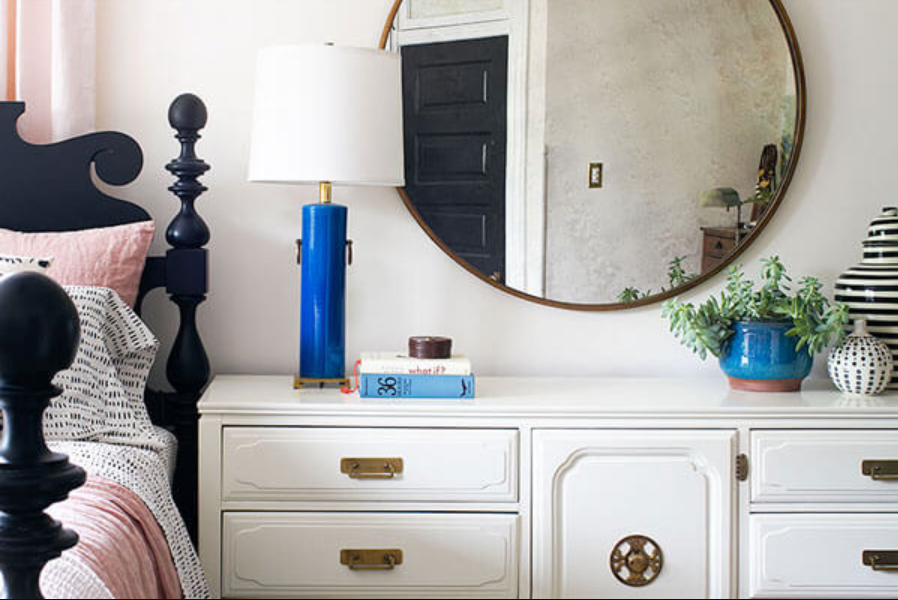
The bedroom mirror is one of the most functional mirrors in your home. A bedroom mirror is usually hung above the dresser. But what is the right size mirror for an upper dresser?
First, you need to measure your dresser table before going to the furniture store to choose your dresser mirror. The dresser table should be wider and taller than the mirror to create a balance between the two. A top dresser mirror balances the dresser. It’s not so big that it can’t fit on the dresser table and not so small that it falls off with the slightest movement.
Size of mirror above bathroom vanity
Bathroom mirror, which is normally hung above vanity, is another functional uses of mirrors in your home.
When it comes to the mirror above vanity, the right size mirror should be long enough vertically to allow everyone a decent reflection. Typically, the mirror should not be wider than the sink or vanity. Basically, the mirror shouldn’t be conspicuously far above the sink nor, unless it is a very large mirror, too close to the sink.
As a rule, the mirror should be several inches less than the vanity or sink area. As an example, if you’ve chosen a 48″ single sink vanity, you should then select a mirror width (frame included) that doesn’t exceed 48 inches. To make sure the mirror doesn’t overpower the room, aim for 42-44 inches total.
Mirror solutions from AntiqueGlass Ltd.
If this article has driven up the desire in you to use a mirror for home decoration, AntiqueGlass has you covered.
If you need help selecting the right size mirror, or help installing your new mirror in the perfect place, our experts can help you out.
Just give us a call today for free quotation and suggestions.
How to choose a wall mirror
A wall mirror can be a serious asset when you’re decorating. Because it reflects light, it helps brighten and widen even the smallest and darkest of rooms to be more comfortable and inviting. A wall mirror can also give your room a decorative look, and it makes an ideal focal point for your space. The key is choosing the right mirror for your room and the look you want to create.
Consider the size.
When you are choosing a wall mirror, the first decision is how big it should be. The size of the mirror should be influenced by a few factors – the size of the wall you are placing it on and how big an impact you want the mirror to make in your room. If you’re hanging a mirror on a large wall in your living room, dining room or bedroom and you want to make a bold statement, choose an extra large mirror, measuring 25 to 31 inches on each side. be in between If you’re using a mirror as an accent on a small wall near your entryway, you may need smaller ones, up to 10 inches on each side. Measure your wall so you know how much space you have to work with and determine how much of it you want the mirror to fill.
Consider the shape.
Although square and rectangular options are usually the most common, you can find wall mirrors in a variety of shapes. A square or rectangular mirror offers the most traditional look, but choosing a mirror with an unusual shape will draw attention to the wall even if the mirror is small or doesn’t have a decorative frame. For a simple yet classy look, choose a circular or oval wall mirror. Funky triangle- and diamond-shaped mirrors can add a quirky touch to a room. If you want to make a big design statement, however, go with a bold starburst-shaped mirror that’s sure to draw the eye.
Consider the style.
Some wall mirrors don’t have frames – it’s their size or shape that gives them a strong presence in your room. When you’re shopping for a mirror, however, you can also choose a style with a frame that packs a decorative punch all by itself. Choose a simple wood, metal or plastic frame for a sleek, streamlined look. For a more formal, dramatic look, look for a mirror with an ornate, gold frame to act as a strong focal point for your room. You can also find wall mirrors with mosaic-style frames that highlight tile pieces for a fun, eye-catching look.
Consider color.
If you decide on a decorative framed mirror, choose an option in a color that works with the rest of the room’s decor. A basic black, white or wood tone frame can coordinate with virtually any decorating scheme. Golden metals such as gold or silver give a posh look that fits well with formal or modern decor. If you’re choosing a wall mirror with a colored frame, think about how the color of the frame plays against the shade of your wall and create a contrast that draws attention to the mirror. You can easily choose a frame in a color that is darker or lighter than the wall, or choose a colored frame with a different undertone than the wall shade to create a natural contrast.
How to choose the right decorative mirror
Few things are as important to the design as decorative mirrors. Mirrors make spaces look bigger, create warmth, reflect light and add interest. What a versatile solution to many design challenges! But choosing the right size, shape and style of decorative mirror for your space can be overwhelming. To make the process easier, follow these steps.
1. Find the perfect size for your space. Scale is important when it comes to choosing wall decor, so ask yourself these questions when looking for a mirror that will complement your space:
- Where am I hanging it?
- What size is the wall space?
If you’re hanging a mirror above your couch (and assuming you’re not pairing it with other wall art), you can go as big as the couch itself to make a big, bold statement. are Or place it three-quarters the length of the sofa to give it just the right amount of presence without being the center of attention.
The same formula applies to mirror grouping. Expand your installation to cover the length of the couch or place a more modified collection about three-quarters of the length of the couch. Both options work well but produce different results. The longer or larger your installation, the more impact it will have in the space.
Good to know: There are no absolutes in design, but a good rule of thumb is to leave at least 1 foot above and below your mirror installation.
When it comes to sizing the mirror above the fireplace, look for something that adequately fills the space between the top of the mantle and the ceiling. You can either have the bottom of the mirror appear to rest on the mantel or center it on the wall.
In general, the style of the mirror helps determine the best perspective. A perfectly rectangular or round mirror looks best when centered. A free-form or round-edged mirror can be anchored to the mantel top.
2. Play with shapes. With a seemingly infinite number of choices available, finding the perfect mirror shape can be a frustrating journey. To give your room a fresh, updated feel, look beyond traditional options for spaces like the entry, dining room or living room. Instead of playing it safe on a small wall, try a larger round to completely change the look and feel of the space.
Walls without architectural details are the perfect canvas for any mirror, but to add instant depth and interest, choose a classic, sturdy rectangle. Find a size that’s either the same size as the piece or about as big as the piece you’re hanging it above.
A mirrored panel wall is a powerful look and can look dated without being flattering. Something that won’t fade into the shadows is your best bet. Create a focal point that stands out against a reflective background by choosing an unusual shape, such as an oval or starburst.
Good to know: Mounting a mirror to a mirrored surface requires a special drill bit and proper hanging hardware to ensure the glass doesn’t shatter. A professional installer is the best way to handle such a delicate task.
f your furnishings have a lot of straight lines and minimal details, soften and balance hard angles by using mirrors with curves. Consider a piece that holds its own and stands as wall art.
If your furnishings have a lot of straight lines and minimal details, use mirrors with curved lines to soften and balance hard angles. Consider a piece that holds its own and stands as wall art.
Charmaine Neithart Interiors
Sometimes a solid square is the best choice. A mirror frame can make or break the way you interact with a room. A frame serves as decoration, and a thin silver frame on an extra-large square mirror would be timeless and elegant but wouldn’t have provided the punch that a thick rustic frame does in this well-edited transitional room. . .
3. Consider your style. Wall decor is just as important as mirrors which, depending on the style you choose, can blend in with your surroundings or add your own flair.
In a sleek, modern or minimalist space, consider that a thinly framed and tall rectangle will visually expand the room in a strong yet subtle way. The less ornamentation a mirror has, the more it will blend in without it.
If you’re looking for something with more edge and attitude, take a risk on a mirror to build a room around. Deep black swirls on a completely unconventional look make this mirror the perfect choice to change the feel of this eclectic room. Hanging beautifully above a spare fireplace and holding court on a sleek coffee table, this powerful piece adds movement and a bit of intrigue.
Contemporary types should look for sculptural or three-dimensional mirrors. Regardless of form, these pieces function as art, complementing their surroundings while remaining unexpected.
Good to know: To get the most out of your mirror, give it a great base. Paint the wall a dark, moody color or paper it in a lush print so that the mirror hangs.
You may gravitate towards a transitional look or prefer a calm, toned-down atmosphere. Maybe accessories or gallery walls aren’t your thing. You can add a lot of style to your space with artistic mirrors. Wrought iron branches, golden leaves, a whitewashed driftwood surround — these are all options that don’t require extra accompaniment.
Everything you need to know to choose the perfect mirror.
Large, beveled, or framed, mirrors reflect your style. Check out our tips to narrow down your search for the perfect mirror.
Mirrors aren’t just for the bathroom or dressing room. A well-placed mirror can add light and style to any room. You can use a mirror to draw a guest’s attention in a foyer or brighten up a room with little access to daylight. They create the illusion of extra space and help add activity and interest to smaller spaces by giving the eye more to see. There’s a mirror for every space and purpose, it just takes a little creativity and understanding to find the perfect fit. Read on for complete details on how to fit a mirror into any room.
Before you shop.
When it comes to decorating any room, it all comes down to the proportions of the space and the items that decorate it, and mirrors are no exception to this rule. Mirrors can either be a focal point for a room’s wall decor, or they can be a helpful accent. This means you have to know how much area you have to work with either way. Accordingly, the first step is to measure the available space where you want to place the mirror.
Measure the wall map, note the size of any furniture that will be under the mirror, such as a buffet table, and how close the mirror will be to windows, doors or light fixtures. When designing the wall decor, note any fixed shelving or electrical outlets that will need to be worked around.
The exact size and shape of the mirror depends on your visual preferences, but if the pieces don’t balance against each other, the space will look cluttered or messy. When you start with measuring the available space, it will help you determine if you want to make the mirror the focal point and arrange everything around it, or if the mirror is to form a secondary accent to add only passing interest. The setting is up to you, so it’s helpful to start with as much information as possible before you make your choice.
How to fit the right mirror size for your space
Mirror size makes a huge difference, but no option is one-size-fits-all. When you choose a size, think about:
- Where is the mirror? The size of the mirror you choose to hang above your mantel will be very different from the size you choose to hang on the hallway wall.
- The purpose of the mirror. Are you emphasizing an art collection or a gallery of family photos, or are you organizing a place to complete your look each morning?
- How much space do you have? Even small mirrors can brighten up a space significantly, but do you want the mirror to be the sole focal point of the room, or would you prefer to mix things up with other decorative elements?
If you want your mirror to blend into the room, choose a larger one — between 25 and 31 inches on each side. A mirror will reflect more of its surroundings and be less distracting than one or more smaller mirrors. It will also make the room appear larger than it actually is.
What you need to know about mirror sizes
• A large, too-small mirror will look out of place on a large wall, so if you’re working with a blank canvas, go bigger.
• The width of the mirror should be two-thirds to three-quarters the size of the furniture below it, or alternatively. If you have a 6-foot buffet, for example, you’ll want a 4-foot-wide mirror. The exception is in the bathroom, where the mirror should be a few inches shorter than your vanity.
• Height matters, so when working with a tall mirror, leave about a foot of reflective surface above and below your eye level when placing the mirror.
What type of mirror will work best in your space?
There are shiny art pieces of all sizes and shapes to choose from, so it’s important to narrow down what type of mirror you’re looking for. What do you plan to use the mirror for: Is it an art piece or will it be used to make sure you brush your hair before you leave the house in the morning? It’s best to figure out what you want to use it for before you start browsing, because the more you look around, the more ideas you’ll have! The choices can be overwhelming, so it can be helpful to have a mirror of some sort in mind to keep your search focused.
Accent mirrors
The right accent mirror can add depth and light to any space. These mirrors can be large or small and are usually decorative, either with a distinct frame, shape, or beveled or carved details. If you’re using a mirror as an accent piece, size and style need to work hand in hand.
Use these tips to choose the right accent mirror:
• If you want it to be a bold focal point, choose a mirror larger than any other decorative element on its wall.
• If you’re adding it to a gallery wall, choose a mirror that matches the frame style of the other art.
Bathroom mirrors
Must be large enough to fill the space above your sink. Choose a mirror that is 2 to 4 inches narrower than your vanity. Center the mirror on the wall above the vanity, with the bottom of the mirror flush with the top edge of the vanity backsplash. For large, framed mirrors, place the mirror on the wall with 6″ clearance above the vanity edge. (This protects the mirror and frame from faucet splash.)
If you are working with a small space, or perhaps want to provide a mirror for a double vanity, choose a mirror design that is the same length as each sink basin. Get creative with shapes by choosing an arched, circular, oval, or specialty mirror, or opt for a standard rectangular or square bathroom mirror. Center the mirror behind the sink, lining up the center of the mirror so that there is at least one foot of reflective surface above and below the eye line of the bathroom’s primary occupants.
Build.com tip: If you’re building a super modern bathroom, choose a mirror with built-in lighting, which can also help you save space on fixtures.